


Mobile Truck Repair Without Towing: How On-Site Fixes Work
Last Updated: November 13, 2026
Quick Summary
Mobile truck repair without towing sends a technician to your disabled truck with the tools and parts to fix it where it sits, skipping the tow and shop queue. It suits faults diagnosable at the roadside that fit a service truck's kit, such as batteries, alternators, tires, air leaks, and brake adjustments. Internal engine failure, transmission teardown, and frame damage usually still require a tow.
Usually fixable on-site: dead batteries, alternator and starter faults, tire and wheel issues, air leaks, and brake adjustments.
Internal engine failure, transmission teardown, frame damage, and major harness damage usually require a tow.
Describe the symptom, not your diagnosis, and give a precise location with mile marker and direction.
Mobile rates cover technician time and the service call, with parts typically billed separately.
Ask whether a second-trip charge applies if a part must be ordered before you authorize work.
Truck down and need it fixed where it sits?
Integrity Mobile sends diesel technicians to your truck for on-site repair and diagnostics.
Table of Contents
When Mobile Truck Repair Without Towing Is the Right Call
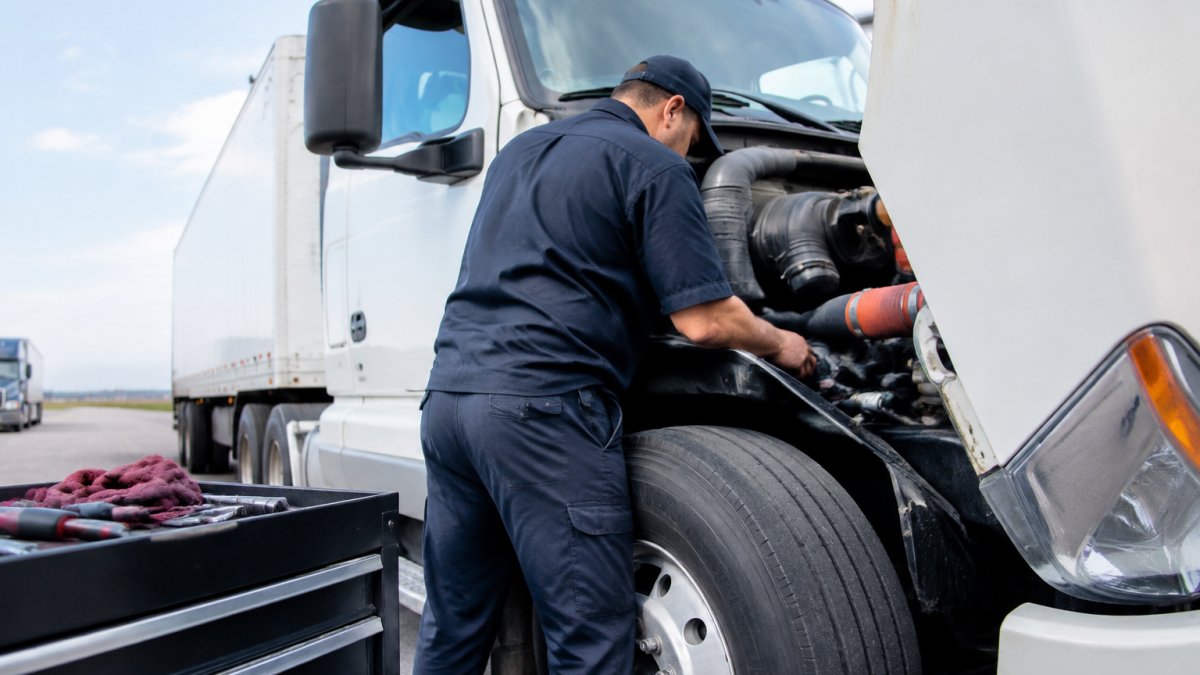
Mobile truck repair without towing is the practice of sending a technician to your disabled truck with the tools and parts needed to fix it where it sits. Not every breakdown qualifies for a mobile repair, and the honest answer depends on the fault and the location. When the fault is diagnosable at the roadside and the repair fits a service truck's kit, you skip the tow, the shop queue, and most of a day's downtime.
The decision comes down to three factors: what failed, where the truck is parked, and whether the repair can be completed safely with traffic moving past. A failed alternator on a wide shoulder is a straightforward on-site job. A cracked block in a live lane on I-35 at 2 a.m. is not.
What Can Be Fixed On-Site vs. What Requires a Tow
Most roadside failures fall into two groups, and knowing which one you're in saves money before the technician arrives. You can review the full range of on-site services to judge whether your issue qualifies for mobile repair.
Usually fixable on-site: dead batteries, alternator and starter faults, tire and wheel issues, air leaks, brake adjustments, fuel and filter problems, coolant leaks, diagnostic fault codes, and reefer faults on many trailer units.
Usually requires a tow: internal engine failure, transmission teardown, frame or structural damage, major electrical harness damage, and any repair that needs a lift or a controlled shop environment.
Watch out: a driver who keeps cranking an engine with a suspected internal failure can turn a roadside diagnosis into a full rebuild. Stop the engine and call for service instead.
The article splits common roadside failures into two groups, so you know before the technician arrives whether to expect an on-site fix or a tow.
Outcome | Typical faults |
Usually fixable on-site | Dead batteries, alternator and starter faults, tire and wheel issues |
Usually fixable on-site | Air leaks, brake adjustments, fuel and filter problems, coolant leaks |
Usually fixable on-site | Diagnostic fault codes and reefer faults on many trailer units |
Usually requires a tow | Internal engine failure, transmission teardown, frame or structural damage |
Usually requires a tow | Major electrical harness damage, or any repair needing a lift |
How to Request Emergency Roadside Diesel Diagnostics Step by Step
A clean request gets a faster dispatch.
Note your location precisely. Mile marker, exit number, cross street, and direction of travel. On a highway, say which shoulder and which side of the road.
Describe the symptom, not the diagnosis. "Lost power and white smoke" tells a dispatcher more than "I think it's the turbo."
Confirm the vehicle details. Make, model, year, and whether it is a semi truck, box truck, or trailer unit.
State your load and schedule. A reefer load with a temperature window moves up the priority list.
Confirm your location against the service area before you commit to a dispatch.
Ask for the estimate process up front. A reputable provider explains how the repair estimate is built before work starts.
Stay reachable. The technician may call with a parts question on the way.
Before you dial, confirm your breakdown falls inside the areas we serve. Dispatch cannot help a truck outside the coverage map, and knowing that early saves everyone time.
What Mobile Diesel Mechanic Hourly Rates Cover
Mobile diesel mechanic rates generally cover the technician's time and the service call, and parts are typically billed separately. Understanding how each line is built is the fastest way to avoid invoice surprises.
The lines on a mobile repair invoice
A transparent provider separates the charges so you can see what you are paying for:
Service call or call-out fee: a flat charge for dispatching the truck to your location. It covers travel and mobilization, not repair time.
Labor: billed hourly or by the job, starting when the technician begins work. Ask whether travel time is billed separately or folded into the call-out fee.
Parts: usually billed at cost plus a stated markup. Ask for the markup before authorizing work.
After-hours and weekend rates: nights, weekends, and holidays often carry a premium. Confirm the multiplier before dispatch, not after.
Second-trip charge: if a part has to be ordered, the return visit may carry another call-out fee. Ask whether the provider waives it when the delay is on their side.
What drives the total up or down
The final bill depends on the fault, the time of day, and the parts involved.
When a tow is still the cheaper path
Mobile repair is not always the lowest-cost option. Ask the dispatcher directly: if the likely repair is a shop job, a tow may be the honest recommendation.
A common mistake is comparing only the hourly rate. A lower rate with a longer response time and a second trip for parts often costs more than a higher rate that fixes the truck once. Ask for the estimate process up front, get the call-out fee and after-hours multiplier in writing, and confirm what triggers a change order before you authorize work. You can review the current service and labor rates before you call.
Seven Questions to Ask a Mobile Diesel Mechanic Before You Book
Ask these before you agree to a dispatch. The answers separate a professional mobile mechanic from a guesser with a wrench.
Are you available 24 hours, including nights and weekends? Breakdowns do not keep business hours.
What is your expected response time to my location? Get a window, not a promise.
How is the repair estimate built, and what triggers a change? You want the process, not a number.
Do you carry the common parts for my fault, or will this need a second trip?
Are your technicians experienced with diesel and semi truck diagnostics?
What payment methods do you accept? Fleet cards matter when the driver cannot pay out of pocket.
What can you not fix on-site, and when would you recommend a tow?
If a provider dodges question three or question seven, that is your answer.
Staying Safe and Ready While You Wait for the Technician
Safety while waiting matters as much as the repair itself.

Pull as far onto the shoulder as the truck allows, set out warning triangles behind the vehicle, and turn on hazard lights. Keep the driver out of the truck cab and well away from traffic, behind the guardrail where one exists. Do not stand between the truck and passing lanes to inspect the damage.
Have your paperwork ready: registration, load details, and any fault codes the dash displayed. Note the time you called and the response window you were given. When the technician arrives, walk the truck together before any work begins so you both agree on the fault and the estimate.
Call for Dispatch and Get Your Truck Fixed On-Site
Downtime depends heavily on how quickly a qualified technician reaches the truck. Integrity Mobile provides 24-hour mobile truck, trailer, and tire repair with on-site service, and our technicians handle diesel diagnostics and semi-truck repair at your location. We accept major credit cards, EFS, COMCHEK, and TCHECK, so a driver on the road is never stuck without a way to pay.
The next time a truck goes down, skip the tow truck and the repair shop queue. Contact our dispatch team with your location and symptom, and we will tell you honestly whether it is a roadside fix or a job for the shop.
A breakdown on a tight schedule tests every fleet manager's patience. Integrity Mobile exists to shorten that test: rapid response times, transparent pricing, and experienced diesel technicians who come to the truck. Get started with Integrity Mobile and get your fleet back on the road.
Frequently Asked Questions
Can you do roadside assistance without a tow truck?
Yes, for many breakdowns. Integrity Mobile provides on-site tire repair and engine diagnostics at your location. If the problem needs a lift or major internal engine work, a tow to a shop is the safer choice. Ask the dispatcher to confirm on-site capability before you commit.
How much should a mobile mechanic charge per hour?
Pricing depends on the job, the parts involved, and the timing of service. Ask for a clear quote before work starts. Integrity Mobile publishes its pricing on its website, so you can review it before you call.
Can you perform major diesel engine repairs without towing the truck?
Internal engine work, transmission overhauls, and jobs requiring a lift usually need a shop. Mobile truck repair without towing works best for diagnostics, tires, brakes, and bolt-on components. The technician will tell you if the job exceeds what can be safely done at the roadside.
What are the drawbacks of using a mobile mechanic?
Mobile mechanics carry limited parts and equipment, so some repairs still end in a tow. Weather and traffic can slow response times, and complex diagnostics may take longer without a full shop. The trade-off is avoiding tow costs and shop wait times. Verify credentials, and confirm the estimate in writing before work begins.
Comments